Tuesday, November 15, 2005

The Dark Side

This is the slightly overdue post about terrorist strategy from the terrorist's point of view. Not the easiest subject in the world to write about but let's get one thing clear straight away: I am fundamentally opposed to everything Islamic extremists stand for. I'm not fond of religion at the best of times but I utterly detest totalitarian religious ideologies. One of the main reasons why I'm so concerned about this stuff is because I think Bush and Blair are, unintentionally, making the problem worse.* I very much want our government's (all government's actually) to work towards eradicating Islamic extremism. To think otherwise would be just plain wrong.

So, now that's out of the way, how do the terrorists think and what are their strategies? Obviously, considerable generalisations are required for this; there are always exceptions to every rule. OK, take a deep breath because here we go.

General Brain Inspection
The one and only time I flew to the United States was in 1999. On the flight, I was given a Visa Waiver Form. This was standard practice and I believe it still is. One of the questions on the form asks if you are intending to commit terrorist acts during your stay in the US. Very clever, I thought, I can just imagine a terrorist being caught because he ticked the yes box. "Curse you evil yankees, you tricked me..." Yes, quite. Cheap shots aside, the question does demonstrate a fundamental misunderstanding of terrorism and terrorists. A real terrorist would never tick the yes box, not just because it would be very stupid but because a real terrorist genuinely doesn't believe that he is a terrorist. He believes he is a freedom fighter or a holy warrior or god's messenger on earth. When he ticks the no box he really isn't lying as such. He believes in his cause absolutely. This is particularly true for suicide bombers.

When Blair says that terrorists use the invasion of Iraq as an "excuse" for their actions, he is equally guilty of misunderstanding (or possibly misrepresenting) the problem. The terrorists might well be horribly twisted but their beliefs are deeply held and even more deeply felt. They really do believe that they're doing what is right. It is undoubtedly an uncomfortable fact but it must be confronted in order to understand the problem and design successful counter-terrorist strategies to combat it.

The other important point is that the terrorists are not insane in a conventional sense. I occassionally call them maniacs or nutters but that's because I want to insult them and express disapproval of their activities. The reality is that they're not mad despite the fact that they're very very wrong about almost everything. Bin Laden and his ilk, the "brains" if you will, are capable of formulating and pursuing complex long term strategies (for convenience I'll use Bin Laden to mean Islamic extremist strategists from here on in). Individual terrorist foot soldiers need to be stable and reliable enough to maintain secrecy while planning and co-ordinating their attacks. Insanity does not lend itself to these sorts of activities. If they really were mentally unstable, they'd be a whole lot easier to catch.

Sucessful Terrorist Strategies
The clever combatant imposes his will on the enemy, but does not allow the enemy's will to be imposed on him.
Sun Tzu, Art of War
The first step in planning a response to any attack is to try to understand what response the attacker was seeking or expecting to provoke. It is, apart from anything else, simple common sense. If the enemy is expecting it, they're probably also prepared for it. This doesn't necessarily mean that the sought or expected response is always the wrong thing to do but it must be understood and the decision on a response must be taken with that knowledge in mind. This applies to counter-terrorism just as it does to traditional warfare.

So, how do the terrorists want us to respond? The September 11th attacks were the defining moment of the war against terrorism so it's probably the best starting point. Bin Laden would have known that the attacks would generate widespread support for the US and revulsion towards him and his followers. This would appear to damage his ability to achieve his goals. What did Bin Laden hope to achieve when those attacks were planned and what reaction did he seek and expect to provoke? It can be split into the specific and the general.

The specific response to Bin Laden and his associates was, as we know, the attack on Afghanistan. I believe that Bin Laden made a serious error of judgement with regard to this. It's quite likely that he did expect and intend for the US to attack Afghanistan in the aftermath of September 11th. Bin Laden probably believed that the attack on Afghanistan could be resisted in the same way that he had resisted the Soviets in an earlier decade. (It's worth remembering that the Islamists believe that it was this campaign which brought down the USSR.) He wanted to ensnare the US military in a long unwinnable campaign in the inhospitable terrain of that country. This would have made the US look powerless and impotent. He would also have thought that the increasingly desperate tactics of the US, as they tried to win the war, would demonstrate his belief that they were indiscriminate killers of Muslims to those who had doubted him. In short, it was supposed to be a trap.

It didn't happen that way. He got it wrong. A combination of overwhelming military power (particularly air power) and a lack of popular support for Bin Laden and the Taleban meant that the war was relatively short. It was, I admit, even shorter than I'd expecetd. Those who had lived under the Taleban's extreme version of Islam were not, for the most part, lining up to defend it. In fact, very many Afghans were extremely glad to see them out on their unholy arses. It was an error of judgement from Bin Laden which could have put the US and its allies in a very strong position. Afghanistan could have been the focus of the battle for hearts and minds; democratic reforms, humanitarian assistance and reconstruction of the country could have severely damaged Bin Laden's "America hates Muslims" propaganda campaign. While these things are slowly progressing, they have been overshadowed by events elsewhere.

The general response to the attacks put paid to the potentially very strong position of the Us and its allies. Bin Laden and his cronies, I've no doubt, understand how this works. The best way to explain it is probably with an analogy. Imagine that all Muslims are represented by 1,000 people packed together in a large hall. A very small number of them are terrorists. A slightly larger number are sympathisers who know who the terrorists are. A slighly larger number again have some sympathy with the terrorists but don't have any involvement with them. A larger number again agree with the grievances of the terrorists but do not support the tactics they use to pursue their aims. The rest don't support the terrorists in any way shape or form. It is impossible to easily tell who belongs in which category. Successful counter-terrorism involves getting the terrorists out of the crowded hall without pissing off everyone else. It is very difficult. Heavy hands are not likely to be useful. The danger is that you'll end up with a room full of very angry people who think you're a vicious indiscriminate thug who hates everyone there. What is needed is an intelligence driven, highly targetted response. Slip in quietly, find those you're now sure are the terrorists and get them out of the hall while causing as little disruption to everyone else as is humanly possible. Absolutely do not target those who are not involved in terrorism, even unintentionally. Word of this sort of behaviour will travel very quickly.

Bin Laden would have known that the US does not have a great record at this sort of quiet but firm response. He'd have known that the nature of the attacks of September 11th would most likely provoke an attitude of suspicion and distrust towards every person in the hall. He'd have known that this, in turn, would generate resentment among Muslims and add weight to his rhetoric of "evil America". Again, it's worth remembering that he believes this to be true. His intention is to provoke the US into dropping the front he believes it maintains and show it's true colours. In this, he got exactly what he wanted. And more.

The US and others launched an attack on Iraq as part of the "war" on terror. Muslims all over the world knew that Bin Laden wasn't in league with Saddam and began to question the motives of the US government. They'd understood Afghanistan, even if they hadn't explicitly supported it, but Iraq was another matter. All of a sudden, Bin Laden's claim that the US was intent on waging a war against Muslims started to look more credible. And the fact that the stated reasons for the invasion were, in the end, wholly unfounded only added to that feeling. Bin Laden probably hadn't expected or planned that but he wouldn't have been able to believe his luck.** A quagmire, just like the one he'd failed to create in Afghanistan, delivered to him on a plate. Result.

And then there were the images from Abu Ghraib and Guantanamo. "You see", he'd have said, "I told you they hate all Muslims. Their talk of freedom and respect and decency is a lie. They're as evil as I've always said they were." Having been seriously off track, his strategy is now very much back on the rails.

In terrorism, there are normally two main aims. The first aim is publicity, pure and simple. Bin Laden got that in spades. The second (and in strategic terms far more important) aim is to generate a massive, indescriminate, heavy handed response from the attacked party which will then drive new recruits to join the terrorist campaign. In almost all terrorist campaigns, the response of the attacked party has been the most powerful weapon in the terrorists armoury. In asymmetric warfare, it's the only tactic which has a realistic chance of delivering any kind of success. Bin Laden got that in large, yellow, four wheeled earth removal machines.

I occassionally hear people say that we can't ignore the threat and I agree. At the same time, Bin Laden would be seriously hacked off if we did ignore him. He'd have lost his most powerful weapon. But, just to repeat one more time, I do not advocate ignoring Islamic extremism. What I advocate is intelligence driven, highly targetted counter-terrorist operations under proper democratic control and supervision. At the same time, a dialogue should be established to show that we take legitimate Muslim grieveances seriously.

The temptation to be heavy handed is undoubtedly enormous. That, and the fact that the terrorists are aware of and exploit it, is part of what makes terrorism so hard to stop. Let's not play their game.

* Unintentionally? In my darker moments I question this. As someone who knows something about counter-terrorism, I do sometimes find it hard to explain their actions as anything other than intentionally provocative. Normally, however, I prefer to give them the benefit of the doubt and assume that they are just very misguided.

** Given the publicly stated enthusiasm for an invasion of Iraq from the Project for a New American Century crowd (which preceeded September 11th by some years) it's possible that he did see it as a possibility. That's pretty speculative though.
Democracy in Action?

This article has been lurking in my inbox for a while and I just got round to reading it today. It highlights reports of incidences of electoral fraud in Ninehev province during the constitutional referendum in Iraq. The claims are apparenty based on secret US military reports and it appears that the allegations are not coming from Sunnis but from kurds and Assyrian Christians. It's hard to say how much credence to give these reports but it's worth reading if you're interested in what's happening in Iraq.

Was that wise?

Been away from the computer for most of today (Mon), so I'll catch up on tomorrow. Wasn't going to blog today but I had to mention this.
If the French social model is so great, why is the country in flames?
Not my words but the words of European Trade Commissioner, Peter Mandleson. (Newsnight, 7 minutes into Monday's broadcast if you want to hear it from the horses mouth*. Latest programme link should work for 24 hours).

Mr Mandelsoon could well be expressing a fair point. I can't really claim to know enough about French society to really make a judgement on that. From what I've heard, it seems to at least be a reasonable question to be asking.

But from the European Trade Commissioner? While he's on camera? Has the man gone quite mad? I may not know a great deal about French society but I'm fairly sure they won't find it particularly amusing. If French newspapers are anything like British ones, Mandelson is about to get creamed (if I knew anything about French cooking, there'd be a reference to it here). Members of the French government are hardly likely to be better disposed towards Mr Mandelson either. Perhaps he just wanted to make his job even more difficult than it already is. Peter likes a challenge; he's a fighter, not a quitter. Seriously though, what was he thinking?

Leaving aside that amazing utterance, the Newsnight report did something I just didn't think possible. While watching it, I actually felt a tiny hint of a suggestion that it might be, at least theoretically, possible to feel a glimmer of sympathy for our Mandy. What an extraordinary feeling. Fortunately, it quickly fades. Still, on the one side, he's got the French saying "give too much away and you'll have 100,000 French farmers parked outside your office every day, for ever", and on the other, he's got the US and the developing countries saying "is that seriously all you've got to offer, you odious little man?". It's not a job for the feint of brain.

It looks like the WTO talks are in a pretty shaky state. I don't really want to go into any great detail today, but I did notice another extraordinary outcome of that report. My opinion on WTO negotiations (in a very small nutshell):
  • The government of the United States of America led by George W. Bush: Good.
  • The European Union: Bad.
That's three shocks in one report, I don't think my heart can take much more. Credit where it's due though, the US government are offering to move a lot further than the EU. Maybe we can use that to shame the French into making further concessions. Of course, anyone who suggested that the French have no shame would be guilty of xenophobia based on crude stereotypes, probably in an attempt to garner a cheap laugh, and I'll have no truck with that sort of thing here. Ahem.

Anyway, I digress. Peter Mandleson, eh, what is he like? Maybe he wants to be forced to resign from yet another job. Who knows, the poor man might be addicted to the rush. It's the only explanation I can think of which doesn't involve him being an idiot.

* I wonder if you imagine the enormous effort of will it took to use mouth in this sentence?

Sunday, November 13, 2005

Two plus two equals?

It now seems pretty clear that Thursday's suicide attacks in Amman, Jordan, were carried out by Iraqis. President Bush has already made reference to these attacks in his Veteran's Day speech.
In the past few months, we have seen a new terror offensive with attacks on London and Sharm el-Sheikh, another deadly strike in Bali, and this week, a series of bombings in Amman, Jordan, that killed dozens of innocent Jordanians and their guests.
Bush mentions this attack as part of his continuing justification for his aggressive approach towards terrorism. It reinforces his determination to give no ground in his "war" against terror. It is, for George, a reminder of the need to stay the course, to continue to show resolve until the job is done.

In a way, I can see how this appears to make sense. Attacks like these are a stark reminder of the dangers of terrorism and of the need to combat it. That isn't in dispute.

What is in dispute is Dubya's ability to combat terrorism effectively. For me, the attacks on Jordan are a sure sign that we're a step closer to the self-fulfilling prophesy I mentioned in the previous post. The President no doubt believes that the squeeze he has applied has flushed the terrorists out of hiding and forced them to act. He believes that he'll eventually win if he just keeps squeezing hard enough.

I fear that the second possibility, that his aggressive actions have created a new generation of terrorists among people who would never before have considered becoming suicide bombers, has not been considered by the President and his advisers. That is, in my opinion, what has actually been happening in the last two years. And I fear it's going to get a lot worse if the US and UK continue with their current strategy.

In some ways, this might be considered a matter of opinion and maybe it is. There are, however, a number of facts which can at least throw a little extra light on the subject. Firstly, how many Iraqi suicide bombers carried out attacks in Jordan before the invasion of Iraq? The answer is none as far as I'm aware. How many Iraqis carried out suicide bombings in total before the invasion? I don't actually know the exact number but I do know that it's a very small number indeed. In fact, I have a suspicion that it might also be zero (but I'm not claiming to be sure of that). There is certainly nothing to suggest that Iraqis had joined the Jihadis in any significant numbers before the invasion.

Two and a half years after the invasion, Iraqi suicide bombers are an almost daily occurrence in Iraq itself and we've now had the first ever Iraqi suicide bombers in a neighbouring country. In short, a country with no history of suicide bombing is now plauged with them and starting to export them to its neighbours. This can only cause greater instability in the region and it only started to happen after the invasion. These facts don't prove anything but I believe they do lend support to my view.

There are also a number of historical precedents for just this sort of counter-productive counter-terrorism. Ten points if you can suggest one. (I hope that doesn't sound smug and patronising. Apologies if it does, it isn't my intention. I've written too many long posts recently so I'm trying to keep this concise.)

Finally, I thought I'd quote the bearded coward himself. In Febuary 2003, just before the invasion, he took time out of his busy hiding in caves schedule to make a statement. There's lots of it. Here are a couple of highlights.
Needless to say, this crusade war is primarily targeted against the people of Islam.
I'd say this is a lie. Most people reading this would probably agree, but that's sort of irrelevant. Bin Laden and his followers almost certainly believe it and, *more importantly*, many people in Iraq also believe it. What's more, it becomes more convincing as the US/UK military attitude becomes more and more heavy handed and indiscriminate in its reaction to the terrorism/insurgency. It's all part of the plan as far as Bin Laden and his cronies are concerned. "Squeeze away Mr Bush", they'll say, "the harder the better".

This final quote really nails down the self-fulfilling prophesy element for me.
Under these circumstances, there will be no harm if the interests of Muslims converge with the interests of the socialists in the fight against the crusaders, despite our belief in the infidelity of socialists. The jurisdiction of the socialists and those rulers has fallen a long time ago. Socialists are infidels wherever they are, whether they are in Baghdad or Aden. [my emphasis]
As was widely reported when the US government originally claimed that Saddam was linked with Al-Qaeda, Bin Laden actually hated Saddam and his regime. Now some people will claim that this was another lie from beardie but that doesn't accord with what independent experts were saying. The experts believed it to be true. In any event, as I understand it, the term "infidel" is not used lightly by such people. They hated each other.

But the actions of the US and UK governments created the "circumstances" which drove the Jihadis into co-operation with the secular, socialist Baathists. There was no co-operation before the invasion. There is now. Self-fulfilling prophesies tend to work that way.

This isn't the post about the terrorist point of view which I said I was going to write in the previous post. Instead, it's a sort of link between the previous post and that new one (which I'll probably write tomorrow).

Unite against Criticism

Dubya hit back at his critics on Friday at an address to commemorate Veterans Day. Some people might think that such an event is highly unsuitable for political charged and controversial statements. George has no such concern. In fact, he's provided a splendidly clear example of the "we must unite against the common enemy" tactic I mentioned in the previous post. No-one does this quite as brazenly as Dubya; even Blair doesn't have the temerity to be so blatant.

Here's the full text of what he said. I've selected a couple of telling quotes.
The murderous ideology of the Islamic radicals is the great challenge of our new century. Yet in many ways, this fight resembles the struggle against communism in the last century.
This is an extraordinary exaggeration. Without wishing to discuss the Cold War in any great detail it's pretty obvious that the threat today is very different. The "struggle against communism" was a struggle against a very large, very well funded nation state. In fact, it was a struggle against a superpower of almost equal strength to the US. The military capacity of the USSR was totally incomparable to the terrorist threat we now face. Millions of well trained, well equipped professional soldiers, backed by an enormous structured state apperatus compared to a group of extremists with limited funding and no superpower state backing. A huge arsenal of nuclear weapons constantly targetted at the US and ready to be launched at short notice compared to the possibility that a terrorist group might aquired and use WMD at some point in the future. In the fight againt communism, the US (and the world) faced the constant possibility of mutually assured destruction. The world as we knew it could have been destroyed at the push of a button. For every hour of every day, for very many years, the US was quite literally minutes from potential destruction.

While the incidents of September 11th were undoubtedly horrific, the idea that "in many ways, this fight resembles the struggle agaisnt communism" is basically laughable. In almost no way does this fight resemble the fight against communism. And yet, Dubya says that it does. It is as bold an example of scaremongering to keep the people in line as you're ever likely to see.

Well, that's not quite true. Towards the end of the speech, George goes even further.
While it's perfectly legitimate to criticize my decision or the conduct of the war, it is deeply irresponsible to rewrite the history of how that war began... The stakes in the global war on terror are too high, and the national interest is too important, for politicians to throw out false charges. (Applause.) These baseless attacks send the wrong signal to our troops and to an enemy that is questioning America's will. As our troops fight a ruthless enemy determined to destroy our way of life, they deserve to know that their elected leaders who voted to send them to war continue to stand behind them. (Applause.) Our troops deserve to know that this support will remain firm when the going gets tough. (Applause.) And our troops deserve to know that whatever our differences in Washington, our will is strong, our nation is united, and we will settle for nothing less than victory. (Applause.)
I doubt I have to spell it out, the message is clear: "We must unite against the common enemy." That means not criticising Bush where it hurts, no matter how unscrupulously you believe he behaved in the run up to the war. If you have doubts, button it. If you do not, you are aiding the enemy and threatening the very existence of the citizens and institutions of the United States of America. You are, in short, a traitor. It is astonishingly blatant. In the UK, Blair has to use the Scum to pursue such obviously manipulative tactics. In the US, the President appears to be able to do it without any help from friendly newspaper owners. I find this extremely worrying.

The real danger is that by exaggerating the scale of the threat, we end up with a self-fullfilling prophesy. I'd argue that this is already happening. Taking a "tough" stance on terrorism (by invading a country with no practical links to the terrorists for example) has increased the terrorists ability to recruit and carry out more attacks. The harder the squeeze, the worse the problem gets. The President then uses the increasing number of attacks to justify squeezing even harder and round we go again. Once that circle starts it is very difficult to stop.

In my next post, I'm planning to write about this from the point of view of the terrorist strategists. This will, I hope, help to further explain why I'm so worried about the President's approach to the "war" on terror.

Friday, November 11, 2005

An Unholy Trinity?

I thought I'd write a little more about terrorism. Well, I'm actually mostly just going to quote from a book I own on the subject. The book is Political Terrorism (2nd edition) by Grant Wardlaw. It was published in 1989 and was required reading for Honours students studying terrorism at Aberdeen University in 1997 (which is why I own a copy). You might get the idea that it's no longer relevant to "this new" terrorism but much of it is still very relevant indeed. The threat of nuclear, chemical and biological terrorism is discussed as is the danger created by the rise of increasingly nihilistic terrorist ideologies. International terrorism, and state involvement in it, is also covered. In fact, the only significant way in which it has dated is in an over-emphasis on kidnapping and hostage taking. In the 80's this was a greater problem for Western countries than it is today.

The chapter I'm going to quote from, chapter 9, concerns the relationship between terrorism and the media.

Terrorism and the Media: A symbiotic Relationship?
(or ' Don't shoot. We're not on prime time')

It is well recognised that some form of symbiotic relationship exists between the news media and perpetrators of spectacular terrorist incidents. One of the most important aims of a terrorist attack is to gain publicity for a particular cause. In some cases, publicity is the sole aim. The presumed primary aim of the news media is to inform. However, it is at least as important in practice to entertain, shock, amuse, or otherwise affect the emotions of the audience, This is particularly true of the medium of television. Competition between media organisations seems to heighten the necessity to focus on the emotion-generating as opposed to the purely informational aspects of news reporting. Terrorists are well aware of this phenomenon and consciously script what have been termed 'live-action spectaculars' - news events which cannot be ignored by the media.
It's worth bearing in mind that when this was written there was far less competition between media organisations than there is today, especially with regard to television news. The relatively recent appearance of a multitude of 24 hour news channels has added considerably to this phenomenon. It is undoubtedly a serious problem. The book then lists a number of ways in which media coverage influences terrorism and our perception of it. For the purposes of this post, I'll just highlight one.
The competitive nature of news gathering places an undue emphasis on the sensational aspects of terrorist events and makes entertainment of public violence rather than performing a public duty to inform.
Before anyone questions the "entertainment" aspect, consider the bold "War on Terror" captions, the breathless reports from the scenes, the use of computer graphics, and the endless repetition of the footage of terrorist incidents. A form of entertainment? I'd say so, even if it is a ghoulish one. It might be considered to be one step beyond watching a really scary horror film.

In this way, by playing to the viewers emotions and emphasising the most shocking aspects, the media distorts terrorism in a way which is not beneficial to the public good. A level of fear is created which is out of proportion to the size of the threat. Terrorism and the media can therefore, in some sense, be said to be two sides of the unholy trinity mentioned in my title. But what's the third?
The response of many governmental and law enforcement officials to these charges is to suggest various forms of restrictions that should be placed on the media reporting of terrorist incidents. These suggestions run from self-imposed industry guidelines to governmental regulation amounting to strict censorship. The spectre of censorship casts long and dark shadows in democratic states and it is therefore necessary to examine both the evidence for the charges which could lead to censorship being imposed and any alternative measures short of censorship which could meet any well founded objections to current media presentation of terrorist events.
Bear with me. In the case of "this" terrorism, the government has shown no inclination to suggest restrictions on media coverage of terrorist events. Now that's partly because the media would vehemently resist such a move (even the Scum, which would probably lead the outcry, no doubt pretending all the while to be unaware of the blatant hyprocisy this would entail). But there's another reason why our government shows no desire to tackle this problem. It's demonstrated in the next passage.
In pursuing these questions we must not indulge in a facile belief that only the media and the terrorists seek to exploit terrorism for their own ends (one for increased audiences and profit and the other for publicity for their cause). Governments, too, are sometimes eager to over-emphasise the seriousness of the 'terrorist problem' to justify increases in the public security apperatus and incursions upon civil liberties. It is an old and well tried trick to divert attention from economic and social problems to focus attention on an ill-defined and frightening 'enemy'. In many parts of the world today, terrorism is such a diversion. In fact, it is possible to imagine governmental officials doing more to destroy democracy in the name of counter-terrorism than is presently likely to be achieved by terrorists themselves.
Does that sound at all familiar? The important point is that "we must unite against the common enemy" is a very old population control technique; it certainly pre-dates democracy itself. There's no real mystery or conspiracy to it. It happens. Often (historically speaking). That's the third side of the unholy trinity, the government itself. It has manipulated and over-stated the terrorist threat to further its own agenda and increase its hold on power.*

There are a couple of points I'd like to make clear before I finish. The government may well be behaving in this way for reasons it believes are entirely justified. Partly, it's undoubtedly driven by a desire to stay in power. Mnay governments have gone down this path, for what they thought were good reasons, only to discover that it leads somewhere very, very unpleasant.

Also, some people might argue that the threat from terrorism is far greater today than it was in 1989. This is debatable but I accept that it is probably true to some extent, and certainly in terms of scale. As such, Mr Wardlaw's warning about government's being the greater threat to democracy might no longer hold. But, try to imagine a process whereby the terrorists are able to damage democracy in this country. Or, if you want a real challenge, try to imagine how the terrorists might "win". How would it happen? Are we expecting our government to surrender to the terrorists at some point? The idea is pretty far fetched. The scale of the terrorist attacks would have to be on a hugely unprecedented scale for it even to begin to be a possibility. From a purely rational standpoint we know that the terrorists could kill a great many more people without doing the slightest damage to the democratic process of this country.** The government, on the other hand, can damage it very easily indeed.

* Again, just to be clear, I'm not claiming that the terrorist threat isn't real. What I'm saying is that democracies have an inbuilt tendancy to over-emphasise the threat faced by terrorism and that this can be a dangerous phenomenon in itself. This is especially true when a government deliberately manipulates public opinion using fear of the "evil enemy".

** The harsh reality is that people die in unexpected ways every day. Far more die in other ways than at the hands of terrorists. That applies for this year, last year, and any other year you care to mention. There are no indications that this is likely to change significantly in the years ahead. Terrorists threaten the lives of our citizens but they do not currently threaten our national security. We should remain vigilant because they may do one day. Crying wolf now though, really is a very dangerous business.

Yet More Integrity

Remember this?
DNA Bioscience does not have any contracts with the DWP [Department of Work and Pensions] or the CSA [Child Support Agency] and it is not currently in any discussions with them about future work.
That was what the Cabinet Secretary wrote in a letter to the Tories at the point when Blunkett was still desperately trying to keep his job. At the time I thought it a bit suspect.

Still, Blunkett did promise to sell back the shares in the company at the original purchase price. Truly a decent and honourable man.

Except, he's changed his mind now. His sons are going to keep the shares after all. And what's this?
DNA Bioscience, which is bidding to win contracts from public bodies such as the Child Support Agency, is expected to be floated on the Stock Exchange next year. [my emphasis]
Of course bidding isn't quite the same thing as being "currently in any discussions" so the Cabinet Secretary didn't actually lie as such. He was just not being entirely honest. Dishonest, that's the word I'm after.

Blunkett's sons are going to be quids in though.
City commentators have predicted that the £15,000 of shares, which are equivalent to three per cent of the value of the company, will be worth about £300,000 after flotation.
Integrity, Integrity, Integrity. That's what's lacking.

Selective Applications

Having studied Economics, I should really be able to discuss the subject with at least a hint of knowledge behind me. Unfortunately, I seem to have forgotten almost everything I ever learned about the subject. It could be a function of the education brain-sponge theory: you fill the sponge through study then squeeze out all that knowledge when you sit exams. The result is, of course, an empty sponge. That's my excuse anyway. It doesn't explain why I remember a great deal more about International Relations, which I studied at the same time, but there you are. It could be that I just found I.R. more interesting. Anyway. I still remember some of it.

Over at Owen's musings, Owen makes some interesting points about how to better share the benefits of globalisation. Suggestion 2 particularly interests me and Owen sums up the problem nicely. Why do we hear so few people advocating a liberalisation of the market for labour at the international level? In economic terms the benefits of such an approach would be very significant (and not just for people in poor countries). If we allow labour to move more freely around the globe, everyone will benefit.*

And yet the debate in this country, as in most other wealthy nations, is dominated by the extent to which we should impose limits on immigration and thus restrict the international labour market's ability to provide economic benefits for all. Economically, this is hard to justify. It is particularly hard to justify when it comes from a party which claims to believe in economic liberalisation and the power of the market. Not that I wish to single out the Tories specifically (well, maybe a little). They are far from unique in their approach.

Owen says this "verges on hypocrisy". To my mind that might be an overly generous description of the situation. Do I dare suggest that there's a latent racism at the heart of this inconsistency? It's certainly something to ponder.

* In economic terms. I've got my own (now outdated they tell me) leftie concerns about an over-reliance on the free market. It seems to me that economic growth has somehow become confused with social wellbeing. They are undoubtedly connected but I don't think they should be considered the same thing. That's a long story for another day though. It's not an easy subject to tackle.

Call in the dogs

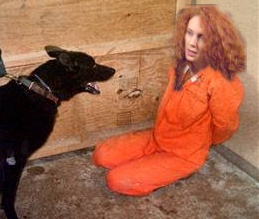
No-one's ever accused me of going too far here yet. Will this do it, I wonder? It does appear to be in rather bad taste.

Rebekah

It's an artists impression* of how Sun editor Rebekah Wade might look if she was ever arrested for being a traitor. Which, of course, she hasn't been.

*Obviously there's a certain amount of artistic licence involved in me even pretending that this is the work of an artist.

Update
Aha, something practical can be done. I'll be spending an hour on that this afternoon.

Thursday, November 10, 2005

Hope

Even in the darkest of days, the courage and decency of ordinary people can be truly inspirational. That's certainly the case with regard to events which happened in Israel earlier this week. Ismail al-Khatib's 12 year old son, Ahmed al-Khatib, was killed by Israeli soldiers who mistook him for an armed Palestinian. Despite that, Ahmed's parents allowed their son's organs to be used to save the lives of those in need, whether Israeli or Palestinian. 5 Israeli children have received transplants.
Khatib said the decision to donate his son Ahmed's organs for transplant stemmed from a desire to answer violence with a concrete gesture of peace. "I have taken this decision because I have a message for the world: that the Palestinian people want peace - for everyone," he said on Sunday. "We have no problem whether it is an Israeli or a Palestinian (who receives his organs) because it will give them life," said the boy's mother, Ablah al-Khatib.
It is an extraordinary gesture of peace. I would suggest that these people take note.

Update
I've created a Wikipedia page for Ahmed. It's the first time I've ever done that so it's a bit rough but I thought it was worth doing. It's also rather short. I might update it some more if no-one else does.

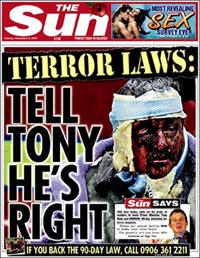
Murdoch's Minions

Today, the Scum calls those MPs who opposed Blair on the 90 day proposals "Traitors". They list (and have photos of) the winners, "Osama Bin Laden, Al Zarqawi, David Davis, Clare Short...", and the losers, the victims of the Londom bombings and their relatives. Truly repugnant behaviour. How well does Mr Kavanagh sleep at night? He writes that "the limit was slashed to 28 days" which is quite clearly a lie. Does he feel any guilt about such a bold misrepresentation on the facts? I suspect his salary dulls the faint objections of his ever diminishing conscience.

That's not all though. (Via)

The Scum

That was Tuesday's front page. John Tulloch, the man in this photo, is a Professor in media studies. He says:
This is using my image to push through draconian and utterly unnecessary terrorism legislation. Its incredibly ironic that the Sun's rhetoric is as the voice of the people yet they don't actually ask the people involved, the victims, what they think. If you want to use my image, the words coming out of my mouth would be, 'Not in my name, Tony'. I haven't read anything or seen anything in the past few months to convince me these laws are necessary.
So they didn't even ask the person in the photo whether he agreed with the Blair/Murdoch line. He didn't.

This gives us one of the clearest signs ever as to how the Scum operates. They have a complete and utter disregard for accurate reporting of the facts. They are, instead, mostly concerned with promoting the political aganda of their owner, Rupert "I pay no UK taxes" Murdoch. The strings are starting to show Mr Murdoch, it really is about time you fucked right off.

Update
Who's the traitor? (via again)

I've done a little more Technorati mood sampling. There are one or two developments on the original BBC story. There are now a small number of posts expressing the opinion that yesterday's vote was a victory for terrorism. Strangely, they seem to be pretty much exclusively from US bloggers. Overall, it's still overwhelming support for the decision of the House. Where are all the outraged Brit bloggers?

It could be the dislike of the BBC thing. I thought I'd check links to the Scum's Terror Bill Defeat story. At the time of writing there's not a single link in support of the Scum. Remarkable.

Sampling the Mood

I thought I'd do the totally unscientific Technorati test to see what people have been saying about our great leader not getting his way on the 90 day limit. Who else linked to the BBC story and what are they saying about it? As I write this, the reaction appears to be overwhelmingly positive. "Three cheers", "Tony got his arse kicked" and "hahahaha" seem to be quite common themes. That's interesting. Where are all the angry people who support the 90 days and feel let down by MPs? I suppose it's possible that many people of that view wouldn't link to a BBC story but still, I really didn't find any. No idea why, if I'm honest. I'll have another look tomorrow.

Harry's Place seems a bit quiet too. Truth be told, I was going to extract the urine over there but they haven't said a single word on the subject, other than to quote Tony Blair's "sometimes losing is the right thing to do" line . Perhaps they're having a strategy meeting. "How can we find a way to blame the rebel MPs for increasing the threat of terrorism? We've just spent the last few months defending Blair's decision to go to Iraq by claiming that only terrorists are to blame for terrorism. This could be tricky..." might be the theme of that meeting (he speculated). I do hope they give it a go, just so I can point and laugh you understand.

If you prefer bloggers to be individuals of independent mind expressing views not shaped by loyalty to our great leader, head on over to The Devil's Kitchen for a rather amusing limerick on the subject. He's looking for more. I should mention that some may be "rather fruity" in tone.

Wednesday, November 09, 2005

A Tribute

A couple of days ago, Pete of The Curator's Egg left a rather splendid poem in a comment to a post. I'm reproducing it today as a tribute to democracy. I had feared that a lament would be required but the House of Commons was having none of it. Here here.

Well, I say "none of it" but "very little of it" would be more accurate; they did double the maximum detention period available to the police. That's something to bear in mind when Saftey says that these MPs have "weakened" our ability to combat terrorism. I've already heard him say it at least twice tonight. Well I never, a downright lie. Who'd have thunk it? But I digress.

And now, over to Pete:

CHARLES, who craved security and ended by putting everyone in prison.

Charles Clarke was one whose tender years
Were plagued by unspecific fears.
Throughout the childhood of this waif
His one desire was to be safe,
No matter what might be the price.
He would not listen to advice
Of those who, older and more wise,
Had swiftly come to realise
That absolute security
Bought at the cost of liberty
Can be too high a price to pay -
And won't protect you anyway!

So thus it was, to tell the truth
The child became a craven youth.
Despite this inauspicious start, he
Went and joined the Labour Party.
At length he joined the good and great -
Became Secretary of State
With policies galore to sell -
But, oh! the lies he had to tell,
Facts to conceal, and on occasions,
Deliberately false evasions.

The good and honest would, if pressed
To do such things, have been so stressed
They would be quite reduced to tears.
But Charlie, driven by his fears,
Was to such feelings quite inured
As long as he could be assured
That SAFETY would be paramount,
All else would be of no account.

No need to care about the loss
Of liberty - who gives a toss?
The most important thing of all
Is building round us all a wall
So no-one can get out or in,
Or else the terrorists will win.
So in our secure little heaven,
Where cameras watch 24/7
We'll be quite safe, and here we'll stay,
Freedom securely locked away (1) -
Safe from those who would destroy it
And from those who should enjoy it.

Thus Charlie brought to middle years
His strangely unspecific fears
And since he never learnt to bear 'em
He made quite sure we all would share 'em.

The moral of this sorry fable
Is - danger is inevitable. (2)
For freedom cannot be defended
By taking measures that will end it,
And if you simply won't attend
We'll all come to a wretched end
As Charlie keeps his hand on nurse
And helps us find that 'something worse'.


(1) Along with all who have opinions
Considered 'awkward' by his minions.

(2) The fact I won't apologise
Will surely come as no surprise
Given the amount of time
I wasted trying to find a rhyme

Happy days are here again...

Those detention without charge results in full:

90 days?
Ayes - 291
Noes - 322

28 days?
Ayes - 323
Noes - 290

28 days it is. There are two seperate consequenses of this result. It's hard not to mix them together but let's give it a go.

The Issue
The proposal was that it ishould be acceptable to imprison people for up to 90 days based on suspicion of involvement in terrorist activities. This has been rejected by the House. I believe common sense has prevailed. A 90 day period would almost certainly have been counter-productive in the overall effort to provide security for the citizens of this country.

The House voted for a 28 day limit. To me, it's still an extraordinarily long time to hold anyone without charge and I'm sure there are better ways round the problem. Allowing the questioning of suspects to continue after initial charges have been made would seem to be a possibility. That has it's own problems but it'd probably be a better solution in my opinion. But, given the available options as they were presented, 28 days has to be seen as a positive result for democracy.

Having said that, there is the rather tricky matter of public opinion to address. Despite the highly dubious polling of recent days, it's probably still true to say a majority of people in this country backed some form of the 90 day proposal. As I've argued before, I believe this is a result of government manipulation of public opinion in conjunction with media terror hysteria.

This highlights a flaw in the democratic process and one that is difficult to overcome. At the risk of straying too close to Godwins Law, consider this:

German Election Results, 1933
  • Nazi Party (NSDAP) - 43.9%
  • Social Democratic Party (SPD) - 18.3%
  • Communist Party of Germany (KPD) - 12.3%
  • Centre Party (Catholic) - 11.2%
  • DNVP (Conservatives) - 8.0%
  • Bavarian People's Party (BVP) - 2.7%
  • German Democratic Party (DDP) - 0.9%
  • All Others - 2.7%
I'm not implying that the situations are directly comparable but they do highlight the same problem. Public opinion is not always the best indicator of what is best for the country. It's a difficult problem to tackle without suggesting some form of intellectual elitist power structure which opens a huge new set of problems. That's part of the reason why democracy can be so fragile and why protecting it properly is so very important. The problem can be overcome to some extent if politicians are open and honest and do not intentionally try to manipulate public opinion in illegitimate ways. Not a luxury we have in this country then. There are no easy solutions but it is important to at least recognise the problem.

As such, I see no contradiction in saying that today's vote is a victory for democracy, despite the fact that public opinion would appear to have supported the government's plans.

The Blair
In this very important case, it's a secondary issue but the margin of Blair's defeat was a joy to behold. The clock has just been wound forward a few notches. Tick tock...

Blair's reaction to this defeat would seem to leave him in an completely indefensible position. He still maintains that he was absolutely right to argue for the 90 days for reasons of national security. He still maintains that anything less leaves the country unacceptably vulnerable to further terrorist attacks. The House did not agree and rejected his proposal.

He says he's going to accept that decision and that is right and proper. But, if he genuinely believes what he says,* he must accept that he, the Prime Minister, has been unable to deliver the changes to the law which he believes are absolutley necessary to protect the citzens of this country. By his own admission, he has not been able to provide the changes he believes are essential to the defence of this country. If that's what he's saying, and that was certainly what he said in a Sky News interview he gave after the vote, then his position is surely untenable.

*I'm sure he's wrong but that doesn't matter here. This is about what our great leader believes.

90 Days?

I originally had this tacked to the bottom of the previous post. On reflection, I thought it'd make more sense to cut it out of there and put a slightly edited version in a new one.


The fact that the police want a 90 days detention period has been repeated ad nauseum by Blair and Blair. As regular readers may know, this doesn't cut much mustard with me. I suspect I've never explicitly stated why that is. Well, it's just become Wednesday, the day of the vote on the proposal. Now would seem as good a time as any.

The police are charged with protecting us against terrorists. Their focus is, as it should be, on preventing terrorist acts and capturing terrorists. For understandable reasons they have a very narrow focus on the problem. In practice, they are not charged with protecting us from terrorism.* Their focus is not on the causes of terrorism except in so far as it helps with their investigations. To deal with that much deeper, longer term problem you need to consider the bigger picture, not just the terrorists themselves. The security services are too close to be able to properly understand that bigger picture.

This is bog standard counter-terrorism theory. Democratic government's absolutely should not allow the security services to set their strategy for counter-terrorism. The security services should be listened to, supported as far as is possible, and be given the powers thought necessary by the democratically elected government. In particular, any requests to extend police powers should be carefully considered. Only if the case is compelling *and* it can be demonstrated that the benefits to society outweigh the disadvantages, should a democratic government consider granting the request. The fact that the police have requested a power should never be reason enough to grant it to them. In a situation where this occurs, the politicians are failing the country and damaging democracy.

It's easy to brush this aside as typical leftie distrust of the security services but that really isn't what it is. There's no need to believe that the security services are not genuine in their actions, no need to accept that all security services are facist control systems, and no need to accept any of the many odd conspiracy theories which get attached to the police, MI5, or the SIS (I know I'm a pedant but it really isn't called MI6). In fact, you can believe that every single person working in the security services is a decent, honourable, well intentioned individual (hardly likely but I'm sure most of them are) but it doesn't matter; democracies should still look very very carefully before granting their requests for more power, especially if it means compromising long held and important principles. These principles are in place to protect our society.

To understand this, all you need is a basic understanding of human nature. It's not that the security services can't be trusted as such, it's just that they're human beings with a specific and very important job to do. They have one goal; to stop terrorists. In such a circumstance, the temptation to use extreme methods, and to seek to aquire new powers over and above those actually needed, is enormous. "Better to be safe than sorry", they'll say. They will see any democratic limits to their investigations, no matter how crucial those limits might be, as an obstacle. So, saying that "the police want more power", well, it's hardly news.

On some occassions, after proper scrutiny, it could be that their requests are justified. After. Proper. Scrutiny.
It is hugely important. The case cannot be made simply by saying that it's what the police want. Police opinion must be considered but the case for the change must stand on it's own merits. I'm sure this one does not.

That's why Blair's endless tedious repetitions of "it's what the police want" are so pathetic. He must know this. If nothing else, advisors must have explained it to him. I guess he just wasn't listening. Either that or he really is an idiot.

* Yes pedants, I'm sure they are officially charged with protecting us from terrorism. In practical terms, that's neither here nor there.

Tuesday, November 08, 2005

New Threats

Acts of terrorism continue to plague us and our friends and allies. The toll of bombings, assasinations and kidnappings bears terrible witness to the indescriminate attacks and lawlessness that rules the behaviour of terrorist groups. It is also apparent that several states have adopted these lawless acts as an instrument of state policy. While we dilligently seek the means to control this scourge, we must also take the steps that are necessary to protect our citizens, our institutions and our friends and allies.

We have, in the course of a detailed review, reached some conclusions on what we must do to protect ourselves, and to assist others in protecting themselves, from this growing threat. Our actions will be guided by the following principles: First, no nation can condone international terrorism. Second, it is the right of every legitimate government to resist the use of terrorism against its people, institutions and property by all legal means available. Third, terrorism is a problem for all nations, and this Government will work as closely as possible with other governments - particularly other similarly threatened democracies - to deal with it.

While we have cause for deep concern about the states that now practise or support terrorism, our policies are directed against all forms of international terrorism. The states that practice terrorism or actively support it cannot be allowed to do so without consequence.
Anyone want to guess who said that? Bush? Blair? No and no. The President's press secretary? That's getting warmer. It wasn't Scott McClellan, the current press secretary, though. And it wasn't his predecesor, Ari Fleischer. No, you have to look back a little further.

It was the Deputy Press Secretary to Ronald Reagan. The statement was issued on April 17th 1984 (it's from page 6). The rhetoric sounds very similar to what we hear today though.* It was issued in conjunction with Reagan signing National Security Decision Directive 138. Much of that directive is still classified but some information has been released and there has been much speculation concerning the still classified sections.
National Security Decision Directive 138, Preemptive Strikes Against Suspected Terrorists, April 3, 1984.
Publicly released portions say the U.S. will "resist the use of terrorism by all legal means available…State-sponsored terrorist activity or directed threats of such action are considered to be hostile acts." Still-classified sections reportedly permit CIA and FBI special operations units as well as existing similar military units to counter hostile "guerrillas" with guerrilla-type operations: sabotage, raids, intelligence collection and preventive operations that might be aimed at enemy operatives. - Center for Defense Information
Blair says the rules of the game have changed. Strange then, that the rhetoric remains the same.

Some people believe that the threat we currently face could have been prevented if Reagan had gone even further and been even more aggressive in his approach. "Bush has declared total war on the terrorists. If only Reagan had done that, they'd already have been defeated by now." That sort of thing anyway. That's basically Blair's approach to the problem. We haven't been tough enough in the past but now that's all got to change. The problem is, there's really no evidence to support the claim that an aggressive approach will be sucessful. Give me one example of a democratic country which has successfully defeated a terrorist threat that way. I can't think of one.

And if we look at Israel, the democratic country with the most aggressive approach to terrorism (for understandable but I would argue misguided reasons), do we see any signs that it might be a successful strategy? No, far from it. It's plain that the Israeli goverment and the various Palestinian factions have become trapped in a circle of violence. "They kill us, we must kill them in return" say both sides. Security can't be achieved that way. All that can be achieved that way is more pain, death, suffering and hate.

The only way in which a democracy can genuinely create security against terrorism is to isolate the terrorists from the wider community. To do this we must open a dialogue with the wider community from which the terrorists recruit (note: NOT WITH THE TERRORISTS). These talks should be aimed at producing agreements on compromises among the more moderate sides of the dispute (note: NOT WITH THE TERRORISTS). If the wider community is supportive, the terrorists will lose power and authority but if the link between the terrorists and the community is not broken, hunting them down is a wasted gesture. Oh look, another one, how unexpected...

In the case of the current terrorist problems, this approach would be very difficult. The wider community is very wide indeed. Many within it already deplore the terrorists. Many agree with some of the terrorists grievances but deplore their tactics. And many, if we're honest, support the terrorists without actually participating directly in any terrorist activity. A very small minority are directly involved. Making sense of all this would be very difficult. Addressing the legitimate grievances of Muslims would also be very difficult. The challenge would be great. That doesn't mean it's not the right thing to do.

The problem with making this point is that some people interpret it to be somehow soft on terrorism, that it might even be motivated by sympathy for the terrorists. You get this sort of thing: "He wants to talk to the evil murdering bastards, like that'll persuade them to stop. How naive can you get blah blah blah?". Another common reaction is that of denial: "He doesn't think the terrorists are real. Fruitloop alert! Doesn't he have a TV? Didn't he see the carnage of July 7th?" These criticisms are based on a cheap and easy caricature of the actual arguments being made. It's a caricature that certain sections of the media deliberately exploit and encourage. It is, if I can be blunt, bollocks.

I'm not going to go into all the reasons why but what I will say is that I absolutely do not take the threat of terrorism lightly. It is a very serious problem and it threatens the lives of the citizens of our country. And the scale of the threat is almost certainly increasing.** Our government should strive to combat that risk to the very best of its abilities. Anything less would be unforgivable negligence. I don't believe the government understands how it can best deliver on that obligation. In fact, I'm sure that they are aggravating the problem with their over-reliance on the heavy hand.

*Actually, there is one obvious giveaway: "it is the right of every legitimate government to resist... terrorism... by all legal means available." The Reagan administration felt the need to maintain a front of legality. The Bush administration is less concerened by that. If the statement had been more recent, it probably wouldn't have contained the word "legal".

** Not changing. I'll try to properly explain why at some point.

Moral Authority

This really isn't funny.

Good post though.

Update
Talk Politics has a message for Murdoch.

Infamy, infamy, they've all got it....

It's navel gazing time. I've had a few extra visitors this week all searching for the same thing. What's that about?

Ah, I see. I'm the number 1 result on Google for "Scootergate". OK, it was just laziness on my part, I couldn't think of a better title, but hey, it's still quite satisfying.

Monday, November 07, 2005

Divide and Rule

It looks like a number of Labour backbenchers may have wilted under the full pressure of the PMs spin machine. 90 day imprisonments are back on the table. Stop the bus now please, I want to get off.

90 days? We're seriously going to be locking people up for up to 90 days because we *suspect* but *cannot prove* that they are terrorists. Strip away all the terror hype. Blair is arguing that it is acceptable to detain a person for 3 months while we look for evidence to prove our suspicions. By the nature of his argument, it can't be denied that in individual cases this evidence might turn out to not actually exist. Innocent people will end up being imprisoned for 90 days for no legitimate reason. This is the price the government is willing to pay to protect our freedom. It. Is. Not. Right.

The saddest part is that it won't even give us protection. Safety has admitted that his proposals wouldn't have stopped the London attacks. No open society can be fully safe from terrorism.

In fact, it'll probably make the situation worse by alienating British Muslims. They'll be the ones who'll soon all know someone who knows someone who was held for 3 weeks, or 3 months and then released without charge. They'll be the one's who become fearful of the police. They'll be the one's who decide they don't want to pass on information to the security services. "So and so did that and they ended up holding him for 53 days... released without charge in the end. No, I'd better just keep out of their way..."

Never mind any of that though, Tony knows best.

Man Seeking Country
Cynical, over-sarcastic, semi-literate blogger seeks new country for fun, adventure and maybe more. Must have a good understanding of the difference between right and wrong. And a good sense of humour. Ready to make a long term commitment if the right offer comes along.
Apply below if interested.

Leading and Following

A YouGov poll for Sky News has concluded that 72% of UK voters support an increase to a 90 day limit for imprisoning terrorist suspects without charge. To be honest, I think government propaganda, propagated with the help of much of the media (for reasons I've discussed in the past) is succeeding to some degree, so I wasn't all that surprised to learn that a large percentage of UK voters supported the 90 day plans. It was disappointing, but not unexpected.

So, I've been thinking about democracy, how it operates, how it can be protected and so forth. Can democracy work when politicians can so easily manipulate public opinion with specious arguments? I had the basic idea for the post I was going to write. It was going to be another dangerous descent into the murky world of liberal elitism.

As a starting point, I had a look for the full poll results. I wasn't expecting to find anything particularly unusual.Truth be told, I just didn't want to link to Sky. The poll was conducted by YouGov and the results are available as a PDF.

Oh, look at question 2. That's surely a leading question, isn't it?
Currently suspected terrorists can be held by Britain's police for up to 14 days. After that they must either be charged with an offence, or released. The police want to extend this time to 90 days, because it can take up to three months to analyse material such as computer files in order to obtain the evidence needed to charge suspects. Which of these statements comes closer to your view?

The police genuinely believe that the current 14-day rule is not enough to protect Britain from terrorist attacks. - 76%

The police don't really need the extra time; they are simply using the debate about terrorism to extend their powers to hold people without being charged. - 16%

Don't know. - 8%
Well, indeedy. I'm not a professional pollster but that looks pretty dodgy to me. In short: Are the police genuine or are they simply exploiting the situation to increase their power. Er, that's an ever so slight simplification of the issue. What about the police being genuine but wrong? That's what I think. My only option would be to vote for answer 1 here. And that's the first step on the road to acceptance.

In fact, all the questions look slightly ropey. Question 3 uses "Critics of the police" as the opening words of the "undesirable " answer. No-one wants to be associated with "critics of the police". Nudge nudge, wink wink, it's the other one. Why not have a look. There are only 4 questions. (I know its a PDF but what's the worst that could happen?) Are they designed to steer you towards the right answer? Hmm.

I genuinely wasn't expecting that. As I said I'm no expert in polling but that one looks decidedly unbalanced. And it was commissioned by Sky News, part of the same stable as the Scum. I wonder where Murdoch stands on this issue?

Is it just me or is there something fundamentally wrong with an Australian media mogul with US citizenship, having so much influence on UK politics and public opinion? Not because he's Australian or American (I think he's both but that's by the by) but because he doesn't live in this country. How can his interference be justified? I don't get it. In the best Australian style might I suggest we all tell Murdoch to "piss off mate".* That's certainly my recommendation.

Anyway, even with a more balanced poll I suspect the majority in the UK would have supported 90 days. That means I'll probably still write that other post at some point. Just not today.

* After a long campaign, Sky TV has now been cancelled here at H2O. We're on Freeview. Huzzah!