Thursday, December 15, 2005

A Narrative of Events

Rachel's message to Mr Blair:
How dare you presume you know our questions and how dare you presume that they can be answered by a 'narrative of what happened', as if we are children to be placated with a story. I know what happened, I want to know why. I want a debate, Mr Blair, I want a dialogue. I will not shut up about it either.
Here here. As with most narratives, before it's published the final manuscript will be subject to editorial control. In this case, the editor is nominally Charles Clarke. In practical terms, it's Tony Blair. That's hardly likely to inspire confidence in the reliability fo the narrative.

The reality is that the decision not to hold a public enquiry into the London terrorist attacks, like so much else this government does, is based on a need to avoid difficult questions about their conduct with regard to Iraq. I'd say it's the largest ever elephant in the room but that really doesn't do it justice.

Scientists today announced that the world's largest and most poisonous, divisive, corrosive, yet strangely almost invisible elephant is believed to be hiding in the political atmosphere of the United Kindom of Great Britain and Northern Ireland. It is, they say, causing unprecedented damage to the political landscape of the country. "This creature is likely to cause lasting, possibly permanant damage unless steps are taken to confront and remove it" said one expert. A Downing Street spokesman dismissed the claims as "ludicrous".

Rachel suggests a course of action. Here here. Again.

Wednesday, December 14, 2005

A Direct and Growing Threat

President Bush has accepted responsibility for the faulty intelligence used to justify the invasion of Iraq. Sort of. It's that new fangled modern political responsibility which involves saying that you take full responsibility and absolutely nothing else. Oh, and he feels he's the best person to make sure it never happens again. (And, of course, he still made the right decision even though that decision was based on "wrong" information.) Right.

Can you imagine that in other areas of life?
Judge: I find you guilty of murder in cold blood. Do you have anything to say?
Murderer: Yes. I accept full responsibility and I intend to conduct an enquiry to make sure it never happens again.
Judge: OK, fair enough. Off you go then.

or
Barings Bank Board: Mr Leeson, your irresponsible actions have caused the collapse of one of the world's oldest merchant banks.
Leeson: Yes, frightfully sorry about that. I do accept full responsibility and I promise it'll never happen again.
BBB: That's alright then. Do you want a reference?

or
IPCC: You shot Mr de Menezes in the head a total of seven times in the mistaken belief that he was a suicide bomber. Did you have any evidence to support this view?
SO 19 officer: No, but it was a sincerely held belief. I accept full responsibility.
IPPC. Okey dokey, glad to have that squared away. Have you tried the new Glock 36 yet?
SO 19: Yes, I've just been issued with one. Beautiful gun.
IPCC: Certainly is. Right, carry on. And please do try to be a bit more careful next time.
SO 19: No problem.

Hang on, that last one might not be such a good example...

Anyway, the full text of today's instalment from the Whitehouse reveals yet another wonder of disinformation. Just the one example:
We removed Saddam Hussein from power because he was a threat to our security.
Talk about unexplainable feelings of insecurity. In what way was he a threat? What do you call someone who exhibits an obsessive irrational fear with no regard for whether there's any evidence to support that fear? It's not a joke, I really want to know.

Bush, today, also referenced a speech he made before the war started. Strangely enough, I'd just been reading that very same speech:
In Iraq, a dictator is building and hiding weapons that could enable him to dominate the Middle East and intimidate the civilized world -- and we will not allow it. (Applause.) This same tyrant has close ties to terrorist organizations, and could supply them with the terrible means to strike this country -- and America will not permit it. The danger posed by Saddam Hussein and his weapons cannot be ignored or wished away. The danger must be confronted... The safety of the American people depends on ending this direct and growing threat. Acting against the danger will also contribute greatly to the long-term safety and stability of our world... A new regime in Iraq would serve as a dramatic and inspiring example of freedom for other nations in the region. [my emphasis]
- President Bush 26th February 2003
It's interesting to compare that view of Iraq with the view of those notoriously wishy-washy liberal-lefties at The Nation in the same month:
[This is] the most outrageous Big Lie of the Bush administration: that delaying an invasion to wait for the UN to complete inspections would endanger the United States. The fact is that for more than a decade the military containment of Iraq has effectively neutered Hussein, and there is no reason to believe that can't continue. Of course, there is a case to be made for keeping up pressure on Iraq to cooperate further with the UN. It is, however, counterproductive to transparently lie to a skeptical world and immoral to denigrate the inspection process because we are afraid it will undermine our cobbled-together rationale for going to war. As Powell knows from his Vietnam experience, lies have a way of catching up with you. Years from now, if the United States is still spending billions trying to micromanage the Middle East and reaping its rewards in blood, Bush will be marked indelibly, like Lyndon Johnson and Richard Nixon before him, as a leader who went to war on a lie. [my emphasis]
In 2003, Bush said "the safety of the American people depends on ending this direct and growing threat". He said much the same today. Whether you choose to believe this is a lie knowingly told or whether you prefer to believe it is the product of ignorance and incompetance is entirely up to you. I see no other ways to explain the statement though; it is, quite undeniably, wrong. Furthermore, very many people could see that it was wrong in February 2003. Bush (and Blair) continued to insist otherwise. Taking responsibility for that is going to take a lot more than a grudging admission that mistakes were made.

As for the long-term safety and stability of the world, consider this:
One country, though, has benefited greatly from the US-led invasion. Iran, increasingly radical, now knows that the United States lacks both the military strength and the political will to attack it.
- John Simpson 14/12/05
Hard to dispute. To call Iran's President increasingly radical is to seriously understate the problem*. Does anyone seriously believe that Saddam Hussein in 2003 was more of a threat to the region and to "the American people" than Mahmoud Ahmadinejad is today? Not likely.

It is, I think, obvious that the invasion of Iraq has fuelled an increase in support for hardliners in Iran and the Iranian government now has a clear motive to increase their defensive capabilities because of what has happened to their neighbour. What makes it more troubling still is that the Iranian President knows he has considerable room for manoeuvre at the moment, courtesy of that same invasion. Is that really "contributing greatly to the long term safety and stability of the world"?.

* At the same time, it's worth remembering that Ahmadinejad is clearly a man who loves the sound of his own voice. Much of what he says is bluster and posturing aimed at impressing a very specific audience. He still has the potential to create a far more serious problem than Saddam was every likely to manage. Iran, unlike Iraq, almost certainly does have the potential to make a nuclear weapon within a few years if it really wants to.

Trust me, I'm the Foreign Secretary

Jack and Friends
Unless we all start to believe in conspiracy theories and that the officials are lying, I'm lying and that behind this there is some kind of secret state in league with some dark forces in the US, and we believe Secretary [of State Condoleezza] Rice is lying, there is simply no truth in claims that the UK has been involved in rendition.
- The chimp 13/12/05
Sometimes you read something and then you read it again and again and again... but no matter how many times you read it, it just doesn't make sense. Does Jack Straw really believe that this statement is a useful defence of the government's position? Trust us?

He's a member of one of the least trusted, most dishonest governments this country has ever had the misfortune to have elected and he wants us to trust him? If ever there was a sign of how out of touch with the real world this government has become, this is it. Trust you Jack? Don't make me laugh.

Tuesday, December 13, 2005

Yipes! It's another dangerous outbreak of be-afraidism. Ruh Roh...

In Pursuit of Peace and Pillocks

I want Iraq to become a stable and peaceful country. Everyone reading this could, I'm sure, honestly say the same. No matter whether we supported or opposed the invasion, none of us wants the violence in Iraq to continue or increase. The people of Iraq have suffered a very great deal for a very long time* and no sensible person would wish them further hardships. So, despite the fact that I opposed the invasion, I desperately want it to succeed now that it has happened. It's hard to see how any other attitude could be justified. (I suppose it could be argued that failure would make future pre-emptive wars less likely and that this might make the world a safer place for future generations. To me, this means being prepared to sacrifice the safety of the population of an entire country based on the possibility that this might be of future benefit to the world and I'm not prepared to accept that for reasons I won't bore you with here.)

The difficulty is that my argument sounds very similar to the sort of thing Blair tends to say when pressed about Iraq. This is because Blair also knows that "it's hard to see how any other attitude could be justified". Politically, the man isn't the halfbrain he so clearly is when it comes to foreign policy. When he says we should "draw a line" under disagreements about his decision to remove weapons of mass destruction Saddam and concentrate on the future of Iraq there's a sense in which I actually agree with him. Yuck. At the same time, there's no way I can draw a line under the way his government has behaved with regard to Iraq, WMD, and, in particular, the spectacularly awful planning and conduct of the occupation. Horrendous mistakes were made and I won't ever draw a line under that until those responsible have been held to account. (Even those who supported the invasion would for the most part I suspect, agree that many very serious mistakes have been made by the coalition in Iraq.)

This isn't an easy circle to square as very many people who opposed the invasion will no doubt attest. How can we possibly support the Iraq project when the people who've made so many catastrophic errors are still the one's in charge? The easy solution is for Blair and Bush to resign. For me, there's more than enough evidence to justify this. To chose just one issue, President Bush's admission that for two and a half years the US military pursued a counter-insurgency strategy that had been abandoned as wholly ineffective in 1969 is utterly inexcusable**. That is an absolutely shameful admission and the fact that it hasn't caused an enormous outcry is something of a mystery to me.

The reality is that, at least in the short term, neither Bush nor Blair shows any sign of going anywhere. Some sort of artificial division, a line in the sand in fact, really does need to be drawn to try to create a cohesive position in the face of this situation. This is my attempt to articulate my version. It comes in two parts and borders dangerously close to doublethink in places.

Part One - In Pursuit of the Pillocks
Whatever your thoughts on the wisdom of the invasion, it can't really be denied that it has been handled extremely badly. From the overstatement of evidence of WMD, to the frankly manufactured evidence of connections between Saddam and Osama, the stated reasons for the invasion were, in the end, untruthful. The manipulative way in which the coalition justified the invasion did great damage to US and UK credibility in the Muslim world and handed an enormously powerful recruiting tool to extremists. This could easily have been avoided by the simple expedient of using the currently popular reason for the invasion from the beginning. Instead, their main justification for the war was based on intelligence they knew to be far less conclusive than they claimed and they got found out when their "sincerely held" beliefs turned out to be sincerely wrong. It's no wonder many Muslims think their intentions were dishonest; I do to. The people responsible for this are pillocks and should be held to account. This is a problem entirely of their own making.

Then there's the occupation. Very few people, I think, are going to argue that the occupation has been handled well. It has been a litany of mistakes from the very beginning. Post-war planning "was as inept and incompetent as perhaps any planning anyone has ever done" according Colonel Wilkerson (Cloin Powell's chief of staff in 2003). From Jay Garner, to that extraordinary Top Gun moment in May 2003, to Abu Ghraib, to more than two years of futile "search and destroy" missions... the list of mistakes is a very long one indeed. The people responsible for this are pillocks and should be held to account. These errors are entirely of their own making. The knowledge required to avoid making these mistakes was (and still is) freely available from any decent university International Relations department.

The chances of Iraq sucessfully achieving stability have been seriously damaged by the flawed justification for the invasion, the almost total lack of post-war planning and the sheer incompetance of the occupation. What was always going to be very difficult has been made more difficult still. Pillocks. Whatever happens in Iraq from here on in, Bush and Blair must be held to account for these inexcusable errors of judgement. Until that happens, I, and I'm sure huge numbers of others who feel the same way, will never tire of highlighting these issues.

Part Two - In Pursuit of Peace
Here's where the line must be drawn. Despite everything in part one, I cannot accept that anyone should want Iraq to continue on it's current violent and unstable path. I want the situation to improve for the people of Iraq. I want this in spite of the fact that it would make it more difficult to hold Bush and Blair to account. I want it in spite of the fact that people would use it to argue that opposition to the war was wrong and probably also use it to point and laugh at people like myself who opposed the invasion***. I don't care. In the end, these are trivialities compared to the problems Iraqis would face if their country falls apart. Such a situation would also undoubtedly destabilise the wider middle east and have serious repercussions for decades to come. I don't think anyone wants that to happen (even though it would make it more likely that Bush and Blair will be brought to book).

That's why I highlighted the results of the survey which showed that Iraqis continue to be optimistic about the future of their country in surprisingly large numbers. It's also why I consider the recent announcement of the adoption of a "clear and hold" counter-insurgency strategy a positive step (extraordinarily inexcusably late but there's still a slim chance that it might not be too late). I'm desperate for good news from Iraq.

And there are some positive signs from the new survey of attitudes in Iraq. (The survey was carried out by Oxford Research International and the results are probably as accurate as its possible to get in Iraq at the moment). Quality of life is improving in some areas and Iraqis remain optimistic about the future of the country. Unfortunately, the survey also contains some uncomfortable bad news****. I think Paul Reynolds provides a balanced analysis of the results. The problem, as with most insurgencies, is that a minority view can and will cause a majority of the problems. The survey doesn't really reflect that and, despite the optimism, the insurgency shows no signs of going away.

The next big test will be the elections and the subsequent attempts to reach agreement on the constitution (that's the constitution Bush confidently declared would be agreed in August 2005, you'll remember). This process was declared a success when the parties agreed to disagree on many issues until after the December elections (ignoring Bush's arbitrary timetable was almost certainly the most sensible course of action given the circumstances). The contentious aspects of the constitution have still to be decided and that's going to be the most crucial issue in the coming weeks and months. Sadly, I still can't see how agreement can be reached on these issues any more than I did in August. If an acceptable agreement can be reached, one which satisfies all parties, it will, I think, have a genuinely positive affect on the stability of the country. If no agreement is reached (or perhaps worse, an agreement is imposed which only has the support of two of the three main groups), instability is likely to continue unabated or even increase.

That is, I think, the situation in Iraq at the moment. US and UK troops will almost certainly start pulling out in significant numbers next year (it's mid-term election year in the US don't you know). Perhaps strangely, having opposed sending them their in the first place, I find myself troubled by this possibility. If they are leaving a stable country with a bright future, then I'll support the decision. If, on the other hand, they're abandoning an unstable country with an extremely uncertain future, as currently seems likely, then I will not. The continued presence of US and UK troops has undoubtedly fuelled the insurgency and at one time I thought it best that they set a timetable to leave. Having stayed for nearly three years, and having pursued a dangerously counter-productive strategy for much of that stay, the situation has developed to the extent that such a withdrawal may well leave behind an even more dangerous situation than that which currently exists.

Whether we like it or not, this war was conducted in our name. We've broken the pottery. We cannot leave without paying. And whatever happens, Bush and Blair, the men ultimately responsible for breaking the pottery in such a reckless and haphazard manner, should be out on their sorry arses.

*A significant part of that suffering has been caused by the actions of Western governments. This starts with the colonial meddling which created it, and includes Western support for Saddam during the Iraq-Iraq war, and, of course, the US-UK sponsored sanctions of the 1990's which killed so many people. The people of Iraq have every reason to resent any Western interference in their country.

** Because I studied this, I can't decide if it's immediately obvious why a "search and destroy" strategy is enormously different to a "clear and hold" strategy. This is not a minor alteration in military tactics but a very major change indeed. If anyone wants me to attempt to explain why it's so significant, I'll certainly give it a go.

*** I can't remember where I first read this but my opposition to the war was opposition to "this war now". It was always going to be a mess, in my opinion, because the people who started it didn't understand the situation they'd be creating in Iraq. I would not have objected to a decent plan to remove Saddam and promote democracy in Iraq. This was not it.

**** For example, this is from page 3 (pdf):
Q6 - From today’s perspective and all things considered, was it absolutely right,
somewhat right, somewhat wrong or absolutely wrong that US-led coalition forces
invaded Iraq in Spring 2003?
  • Absolutely right - 18.6%
  • Somewhat right - 27.6%
  • Somewhat wrong - 17.2%
  • Absolutely wrong - 33.1%
  • Difficult to say - 3.5%
That compares to 12.9% for "somewhat wrong" and 26.2% for "absolutely wrong" in 2004. Support for the invasion is slipping and that's a serious worry. The implication is that as the occupation progresses, it causes more people to think they'd have been better to stick with Saddam.
Monday, December 12, 2005

Plausible Deniability

"Careful research has been unable to identify any occasion... when we have received a request for permission by the United States for a rendition through the United Kingdom territory or airspace."
- Jack Straw

Jack and Friends

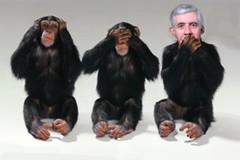
Shh...

Update
It seems that everyone knew about rendition flights except us ordinary folk (via DK):
The European Union secretly allowed the United States to use transit facilities on European soil to transport "criminals" in 2003, according to a previously unpublished document... EU officials confirmed that a full account was circulated to all member governments, and would have been sent to the Home Office.
Meanwhile, elsewhere:
From a general point of view, the rapporteur underlined that the information gathered to date reinforced the credibility of the allegations concerning the transfer and temporary detention of individuals, without any judicial involvement, in European countries.

Legal proceedings in progress in certain countries seemed to indicate that individuals had been abducted and transferred to other countries without respect for any legal standards. It had to be noted that the allegations had never been formally denied by the United States. The rapporteur takes note of the situation and deplores the fact that no information or explanations had been provided on this point by Ms Rice during her visit to Europe.
- Council of Europe press release on the statement by Dick Marty, rapporteur of the Committee on Legal Affairs and Human Rights
It looks like there's about to be a serious plausible deniability failure here.
On my way out for the day but I couldn't leave without mentioning this. It looks like there might be some legitimate good news from Iraq today. As a pampered westerner, I can only applaud the courage and spirit of the Iraqi people. More on this later, I supect.

Sunday, December 11, 2005

Airbrushed Democracy

In March of this year, Laura Bush visited Afghanistan. She said:
We are only a few years removed from the rule of the terrorists, when women were denied education and every basic human right... That tyranny has been replaced by a young democracy and the power of freedom is on display across Afghanistan. We must be mindful though, that democracy is more than just elections. The survival of a free society ultimately depends on the participation of all its citizens, both men and women.
News from Afghanistan very rarely appears in western media reports and many people assume that this is because the media isn't that interested in reporting success. Some progress has undoubtedly been made but the reality is that Afghanistan is still a long way from becoming a successful and stable democratic country. Warlords and drug smugglers continue to exert control over much of the country and strict Islamic laws are still enforced in many rural areas. These areas are not yet fully under the control of the central government of Afghanistan. This is, I think, common knowledge.

What might not be so well known is the extent to which extreme Islamic laws are still being enforced within the new governmental structures implemented since the fall of the Taliban. A Washington Post report on the plight of Ali Mohaqeq Nasab highlights some of these issues. Nasab is currently serving a two year prison sentence for blasphemy. The head of the public security division of the attorney general's office has called for his execution if he does not repent his crimes. And what heinous crimes could warrant such a call?
In his magazine, Nasab suggested that a woman's testimony in court should be given the same weight as a man's, rather than half. He also questioned whether cutting off the hands of thieves was too severe a penalty. Finally, he argued that it was up to God, not to man, to punish Muslims who convert to another religion.
Even in an increasingly authoritarian country such as the UK, you'd struggle to get arrested for "crimes" like these. In Afghanistan, this sort of behaviour warrants two years in jail and the possibility of (legal) execution.

Of course, the power of freedom is on display across Afghanistan. In fact, I'd say it's particularly visible during staged press appearances by notable US visitors.

Here are some facts which remain once the cameras have been switched off and packed away:
  • In Afghan law, a woman's testimony is still considered half as important as that of a man.
  • In Afghan law, the amputation of hands is still considered a legitimate punishment.
  • In Afghan law, non-adherence to strict Islamic belief is still a crime (that's belief mind).
  • In Afghan law, publicly questioning the wisdom of these laws is also still a crime.
  • In Afghan law, Sharia law is still the foundation on which everything else is built.
Visit Afghanistan: the world's foremost beacon of democratic reform.

Hear no evil, see no evil...

Until recently few people had heard of “extraordinary rendition”, the practice of seizing terrorist suspects in foreign cities and spiriting them away to other countries to be interrogated. Condoleezza Rice, the US secretary of state, will have wished that knowledge of the practice had remained confined to the intelligence community.
- Sunday Times, 11/12/05
The Sunday Times starts an otherwise perfectly sensible comment piece by claiming that public knowledge of extraordinary rendition is a recent development. Perhaps a more accurate opening sentence would read something like this:
Until recently few mainstream media outlets had seen fit to report on “extraordinary rendition”, the practice of seizing terrorist suspects in foreign cities and spiriting them away to other countries to be interrogated.
As most bloggers will probably know, 'knowledge of the practice' actually escaped the narrow confines of the intelligence community some considerable time ago.

The Sunday Times, even when saying something I agree with, finds the time to imply that knowledge is only of value if it has been provided by the large media organisations; a fact is only a fact once they've told us that it is a fact. We can't have people thinking for themselves, after all. I mean, people like that are really very difficult to control... Where would it end?

There's a potentially interesting post in that concerning the power of the MSM to legitimise knowledge and the ways in which that power can be used and abused. It's a subject which is almost certainly of great interest to Rupert Murdoch, the enormously influential evil oligarc media mogul. I'm sure we'll get back to that.

So, extraordinary rendition is now "public knowledge". What happened to Maher Arar is no longer part of an America hating, loonie leftie conspiracy theory designed to bring down the US government and install an Islamofacist Stalinist junta in its place. The existence of false allegations of links between Saddam and bin Laden can now be explained and understood without resort to tinfoil hattery. The considerable evidence of abuses under the extraordinary rendition process have finally become "official" news. I suggest that's because the evidence was getting rather difficult to ignore.

Now that the US government's initial policy of ignoring these allegations has become unworkable, the Whitehouse is turning to plan B. This plan requires the repeated deployment of very carefully worded denials of certain aspects of the process. These denials are specifically designed to appear to say more than they actually do.

To work properly, this plan depends on the media not asking the awkward questions which might expose these half truths for what they are. Recently, there's some evidence to suggest that the media no longer wants to play ball. For example, the state department's top legal advisor, John Bellinger, recently stressed that the International Committee of the Red Cross had access to "absolutely everybody" held by the US administration at Guantanamo Bay. But:
When asked by journalists if the organisation had access to everybody held in similar circumstances elsewhere, he said: "No". He declined to explain further.
Watch the right hand. The right hand is doing the right thing. Do not ask what the left hand is doing.

Friday, December 09, 2005

IPCC 'Press Conference'

An IPCC press conference today has triggered an unfortunate outbreak of 'inverted comma' headlines. I read recently (can't remember where, sorry) that the BBC were trying to avoid doing this but they don't seem to have managed today:
Tube shooting charges 'possible'
The Telegraph goes with:
Police 'may be charged over tube shooting'
And ITN News gets it horribly, horribly wrong:
Police 'likely' to be charged over de Menezes shooting
That isn't what was said at all. Someone at ITN needs a good kick up the backside for that one.

In short, the IPCC has said that it is 'likely' that their final report into the shooting of Jean Charles de Menezes will be passed on to the Crown Prosecution Service (CPS). If that happens the IPCC report will include a list of criminal offences which may have been committed. It is then up to the CPS to decide whether anyone can or should be charged with any of these possible offences. No-one has said that any police officer is 'likely' to be charged at this stage.

The timing of this announcement is difficult to understand. The statement issued on behalf of the de Menezes family said:
We have supported the IPCC and the family have always accepted that the IPCC investigation would remain confidential. It is therefore very alarming that the IPCC have inexplicably released partial information in this manner to the media. The IPCC recently announced it was investigating the information released by the Metropolitan Police in the hours following Jean Charles's death, including off-the-record briefings to journalists. We are dismayed to find that the IPCC appear to have adopted similar tactics. The IPCC's credibility has already been brought into question following the leak of key witness statements in August. These additional revelations can only undermine its credibility.
I agree. What is the IPCC playing at? The final report is due in January so why have they decided to tell us today that this possible future action is 'likely' but that they could 'not give a complete guarantee of that'? It doesn't seem to make any sense, especially from an organisation which claims to take the confidential nature of their work so seriously. It appears that they might have broken their own rules by talking about this before their investigation is completed.

I'd like to think there's still a chance that the investigation won't be a whitewash but this sort of strangeness just adds fuel to my doubts. Anyone have any idea why the IPCC made this announcement today?

Thursday, December 08, 2005

No torture please, we're British. Well done, your lordships. You've got to ask how we ever got to the stage where this even needed to be said. As Dominic Grieve put it, this is "a completely correct restatement of a law that has existed for hundreds of years". I must stop agreeing with Tories but the man's quite right on this occassion. Safety's assertion that "this issue is hypothetical" might sound a little hollow if you know who Craig Murray is.
The former inhabitants of the Chagos islands have launched another legal challenge in an attempt to force the government to accept the High Court decision (in 2000) that they are legally entitled to return to their homes. The Disillusioned kid has the details.
"Maya Anne Evans, 25, a vegan cook from Hastings, was found guilty of breaching Section 132 of the Serious Organised Crime and Police Act. She was arrested in October after reading out names of soldiers killed in Iraq at central London's Cenotaph."
Serious Organised Crime? Miss Evans is obviously on a par with that other notoriously dangerous criminal.

Now I'm Terrified

Over the course of this war, we have learned that winning the battle for Iraqi cities is only the first step. We also have to win the "battle after the battle"
- President Bush, 7th December 2005 [my emphasis]
Bush says "we have learned"? Its part of his attempt to persuade us that he does understand what's actually been happening in Iraq. Big, no enormous, no gigantic problem though:

General Abrams learned this in 1968. I learned it at University in 1997 and I didn't have to fight a f*c*ing war to learn it either. To have a President be so totally ignorant of the military history of his own country is totally and utterly terrifying. Maybe if he hadn't managed to avoid going to Vietnam he'd know a little more about it but he clearly knows nothing. People are dead today who might be alive were it not for this inexcusable idiocy.

This quote is absolutely in context:
Over the course of this war, we have learned that winning the battle for Iraqi cities is only the first step. We also have to win the "battle after the battle" -- by helping Iraqis consolidate their gains and keep the terrorists from returning. Used to be that after American troops cleared the terrorists out of a city and moved onto the next mission, there weren't enough forces, Iraqi forces, to hold the area. We found that after we left, the terrorists would re-enter the city, intimidate local leaders and police, and eventually retake control. This undermined the gains of our military, it thwarted our efforts to help Iraqis rebuild and led local residents to lose confidence in the process and in their leaders.
This was exactly the mistake General Westmoorland made in Vietnam. How can he be so f*c*ing ignorant? It simply beggars belief. He appears to be so ignorant that he hasn't even realised how ignorant the comment makes him sound. It is extraordinary.

Normally I try to avoid name calling and I don't have an irrational hatred of Bush (a very rational intense dislike maybe but not an irrational hatred). I do believe that this short admission, on its own, provides compelling evidence that he's either grossly negligent in his duties, a moron, or both.

Wednesday, December 07, 2005

Selling the War Effort

President Bush gave another speech on the Iraq and the War on Terror today. The emphasis was rebuilding. If I had the time, I'd point out everything I find objectionable, misleading or just plain wrong in this statement but I don't have that much time so I'll just have to chose the most striking examples. I'm a little steamed up.

Let's start with the headline:
President Discusses War on Terror and Rebuilding Iraq*
Once again, let's just acknowledge the fact that Iraq was not involved in the global "war" on terror until the US administration decided that it should be. Dubya just cannot pass up any opportunity to portray the invasion as an inevitable part of the GWoT. To be honest, I find this contemptible. It is willfully disingenuous and misleading and the US administration does it constantly.

Let's be clear: if al Qaeda terrorists are ever able to "use Iraq as a base from which to launch attacks against America, overthrow moderate governments in the Middle East, and try to establish a totalitarian Islamic empire that reaches from Indonesia to Spain" it will be in large part due to the many horrendous errors of judgement that this president has made. I'm more than prepared to make a list if anyone doubts it. In February 2003, Saddam was a brutal dictator and a threat to his own people but he was powerless to influence events outside Iraq to any significant extent. Today, the US and UK governments have created a situation which is far more dangerous to the region and really does have the potential to provide a base for international terrorists. Bush and Blair have taken an enormous risk by choosing to invade Iraq.

Some people argue that we shouldn't base our decisions on the actions of the enemy and this is a fine moral principle. In reality, that's very often exactly what must be done, especially in times of war. And they do say they are at war. Constantly. A couple of examples which I have given before. The enemy is carpet bombing your cities daily and killing your citizens by the tens of thousands. Do not build anti-aircraft defences in the remote countryside arguing that we shouldn't base our actions on those of the enemy. Noble maybe, but stupid definitely. Or, France is about to attack. Crack French troops are ready to invade across the channel. Our defences are stretched and we might not hold them off. Do not send all our troops to invade Denmark arguing that we shouldn't base our actions on those of the enemy. Definitely not noble and very definitely stupid.

The terrorists are not currently as dangerous as the enemies in these fictitious examples and are never likely to be but the point remains. In the real world, strategic decisions must take account of the current and likely future actions of your enemy. A soldier who doesn't understand that will very quickly be a dead soldier.

Sigh. I can see I'm not going to get very far through the speech. Next point:
On September the 11th, 2001, our nation awoke to another sudden attack. In the space of just 102 minutes, more Americans were killed than we lost at Pearl Harbor.
September 11th is related to Iraq how? The President of the United States of America is hiding behind the dead bodies of nearly 3,000 Americans (nearly 5,500 actually) to try obscure the many failings of his Iraq policy. It is disgusting, simple as that. And evoking Pearl Harbor? Japan, 1941 and Al Qaida, 2001: compare and contrast. I'm not even going to bother. Next point:
Yet the terrorists have made it clear that Iraq is the central front in their war against humanity. So we must recognize Iraq as the central front in the war on terror.
Ahem:
Confronting the threat posed by Iraq is crucial to winning the war on terror.
- World's most disingenuous President, October 7th, 2002
Bush chose Iraq as the central front in the war on terror long before the extremists moved in. And that quote from the 2002 speech is almost immediately followed by:
Saddam Hussein is harboring terrorists and the instruments of terror, the instruments of mass death and destruction.
That's might be downright lies rather than disingenuousness. Anyway, back to today:
This is an enemy without conscience -- they cannot be appeased. If we're not fighting and destroying the enemy in Iraq, they would not be leading the quiet lives of good citizens. They would be plotting and killing our citizens -- across the world and within our own borders. By fighting the terrorists in Iraq, we are confronting a direct threat to the American people -- and we will accept nothing less than complete victory.
As regular visitors will know, I'm aften pointing out that an attrition based counter-terrorist (or insurgent) strategy is just stupid. The assumption behind it is that there are a finite number of terrorists and that killing them will solve the problem. That's dangerous nonsense. Ask anyone who's studied counter-terrorism and they'll tell you that this sort of thinking is incontrovertably wrong "Did that come from some wet behind the ears fresher?", they'd ask (once they'd stopped laughing). How can it be that the President of the most powerful country in the world is putting forward a proposal which is based on an entirely erroneous assumption? Seriously, it scares the sh*t out of me.**

This also appears to be yet another acknowledgement that Iraq was always intended to be a "flytrap" for terrorists. So what if some Iraqis get killed? And if a couple of thousand military bods end up dead, well they're mostly working class. Not nearly as important as high powered NY executive types... Is that the subtext? What right does Bush have to chose to wage his war on another country's soil anyway?

Those are just some points from the first third or so of the speech. There's lots more I could add but I'll leave it there. I'm not at all confident that this President can ever deliver the victory he declared on May 1st, 2003. I have one other section I'm going to highlight in a seperate post. It's really got my blood boiling.

* Some might say that Bush didn't write that headline so I shouldn't hold it against him but then I doubt he wrote very much of the speech either (US Presidents rarely do) and he's the boss at the end of the day. If you're looking for the buck, there's really only one place it can be.

** Trying to stop blog swearing. Again.

Ya Boo Ya

At Aberdeen University, myself and some of my friends liked to entertain ourselves by mocking the public school crowd.* It wasn't difficult. Conversations like this were common:
Ya 1: What are you doing over the Christmas break, Tarquin?
Ya 2: Daddy's taking us all to Cortina d'Ampezzo, ya.
Ya 1: Super. I went there last year. Cortina is simply divine and the shops are wonderful.
Ya 2: That's what daddy says. And the prices keep the proles away so you don't have to put up with those ghastly queues at the ski lifts.
Ya 1: Ya, that's a joy. I really hate to queue with the great unwashed...
OK, I exaggerate slightly but only slightly. We called these people Ya's because they tended to say "ya" instead of "yes" or indeed "aye" as is common in Aberdeen (can you taste those sour grapes?). For some reason, most of these people appeared to come from Edinburgh although that's really neither here nor there.

I was reminded of this today while watching Prime Ministers Questions. Two public school boys having a friendly chat and all that. Cameron wants to take the "punch and judy" out of PMQs apparently; instead of ya boo, we're going to get ya ya. That's a novel approach.

Well, sort of. As I remember, that's exactly the attitude adopted by Blair when he took over the leadership of the Labour Party, is it not? And, if memory serves, PMQs are now held in one 30 minutes session on a Wednesday instead of two 15 minutes sessions on Tuesday and Thursday because Blair said it would lead to more serious debate and less theatrical posturing. The public have had enough of this pantomine, he said. How long did that last? Cameron's new approach is likely to last just as long.

As I write this, the BBC news front page offers a link so you can "watch the clash" (sadly, this doesn't lead to a live performance of London Calling). I have to say that the media are as much to blame as the politicians for the confrontational nature of British politics. They want a fight and they're going to get one, whether the participants are willing or not. I doubt DC is going to be able to do anything about that.

Anyway, I thought the boy done OK. He really did silence the Labour benches with "The government chief whip shouting like a child. Has she finished, have you finished?" I very much doubt that she, or anyone else in the Commons for that matter, has finished shouting like a child. It'd be like expecting children to stop doing it; it's just not in their nature. We can but hope. All in all though, a decent first appearance from the young pretender. I still won't be voting conservative but then I doubt anyone thought I would.

Just one other thing about PMQs while I'm here. Is there any point whatsoever in sychophantic Labour MPs standing up and slavishly asking if "my right honourable friend will agree with me that we are great and the party opposite is rubbish"? These desperate for promotion toadies could at least put in a bit of effort to try to disguise their intentions if nothing else. Is that really too much to ask of our elected representatives?

* I'm mostly a product of the Scottish state education system. I did attend a small private international school in the Netherlands for the last three years of my education (my father's employer paid for that) because there wasn't really any other option available. I've got an International Baccalaureate, which I still can't spell without looking up, instead of Highers or A levels if anyone's interested. I certainly wouldn't consider myself to be public school.
So David Cameron won the Tory leadership doodah. It seems that we're going to get lots of compassionate conservatism from here on in. Nick's blog offers an insight into how that's going so far. Oops indeed. I was impressed to discover that there is such a thing as society after all. Well spotted DC. Whether he can put some flesh on the bones of his very Blairy rhetoric of aspiration remains to be seen. I hope he does. It might just make the Labour Party sort themselves out. His first PMQs should be interesting.

Tuesday, December 06, 2005

Strategies for Victory

The training of the Iraqi security forces is an enormous task, and it always hasn't gone smoothly. We all remember the reports of some Iraqi security forces running from the fight more than a year ago. Yet in the past year, Iraqi forces have made real progress. At this time last year, there were only a handful of Iraqi battalions ready for combat. Now, there are over 120 Iraqi Army and Police combat battalions in the fight against the terrorists...
- President Bush 30/11/05
A consistent problem with the US strategy in Iraq has been an apparent inability to honestly describe the situation on the ground. When the administration launched the "National Strategy for Victory in Iraq" there was an obvious attempt to address that problem in some way. Dubya admitting that "it hasn't always gone smoothly" is a case in point. My fear is that this is simply a change in rhetoric designed to disguise the fact that they're still painting a picure of progress which isn't reflected in the real world.

President Bush says that real progress is now being made in the training of the Iraqi security forces. The Vice-President of Iraq disagrees. Ghazi al-Yawer, a moderate Sunni, claims that the training of Iraqi security forces has suffered a serious setback in the last six months.
Al-Yawer said recent allegations that Interior Ministry security forces dominated by Shiites have tortured Sunni detainees were evidence that many forces are increasingly politicized and sectarian. Some of the recently trained Iraqi forces focus on settling scores and other political goals rather than maintaining security, he said. In addition, some Iraqi military commanders have been dismissed for political reasons, rather than judged on merit, he said.

He said the army, also dominated by Shiites, is conducting raids against villages and towns in Sunni and mixed areas of Iraq, rather than targeting specific insurgents, a tactic he said reminded many Sunnis of Saddam Hussein-era raids. "Saddam used to raid villages," using security forces, he said. "This is not the way to do it."
Indeed. In an admittedly slightly facetious post last month, I tried to make the same general point:
Seriously, having over 200,000 armed security bods of questionable loyalty in a highly unstable country is not something I'd be inclined to boast about.
Bush likes to talk numbers. We've trained x number of people and have y number of battalions and so on. This is totally beside the point if the people being trained are not using that training in a useful way. Mr al-Yawer doesn't seem to think that they are. In fact, he's worried that many of them are acting in a very dangerous way and that they may be further destabilising the country. That's pretty much exactly the point I was trying to make.

There are many historical examples of just this sort of thing happening. The "West" trains up the population of the "liberated" country in military strategies and tactics, and supplies them with the necessary military equipment to defend themselves and keep order. Once trained, the population then put their new strategies and equipment to use in ways which the "West" had never intended. Civil wars, wars with neighbouring countries, and wars against the people who initially trained them are all par for the course. So when Bush says "there are over 120 Iraqi Army and Police combat battalions in the fight against the terrorists" it genuinely does make me worry. It clearly makes the vice President of Iraq worry too. Military training is one thing; loyalty and proper democratic control are another thing altogether.*

We know that the Iraqi security forces have been inflitrated by various militia groups although we don't really know to what extent. We (I anyway) also don't really know how the "coalition" intends to deal with the problem. As things stand, it appears that these infiltrators are included in all the figures of readiness given by the US administration.

Today, 43 people have been killedat the Baghdad police academy by two suicide bombers. Spectacular terrorist attacks like these generate some coverage in the western media although not a great deal. The sectarian and tribal violence which is part of everyday life in Iraq get almost no coverage at all. Mr Bush can continue to paint his pretty pictures in Washington. In the real world, the picture is very different. Much of the canvas remains blood red.

* I have an idea for a realistic way to judge the dependability of the Iraqi security forces. How many Iraqi battalions would a Fox News reporter be prepared to go on patrol with on the streets of Iraq (without US military support)? Right now, I suspect the answer is zero. When western journalists are prepared to put their lives in the hands of these units then they can start telling us how so much progress is being made in the country.

The Lunatics are on the Grass

Stephen Green and his band of fundamentalists have been busy again. More info here. I've send comments to both Sainsbury and Woolworth telling them they won't be getting any money from me for the foreseeable future.

Unfortunately, Aberdeen probably has more of these extreme Christian types than the average British city. The writer of Jerry Springer: the Opera, Stephen Lee, was in Aberdeen yesterday and was heckled by Christian fundies who'd like to save us from ourselves. He was forced to cut short his appearance by these hecklers. A protestor said:
I have read part of this and it's dreadful. It's absolutely vile and is an insult. This poor man who wrote this play is obviously hurt in some way and he hates Christians and Christ. God help him when he meets his maker.The script is filth and shouldn't be shown in Aberdeen. It should be sent back to hell where it belongs.
God help him when he meets his maker? Well, according to their beliefs, at least help wouldn't be far away...

Another protestor travelled from Braemar to attend the protest (that's about an hour and a half away by car). He said "I would not go and see it any more than I would go and watch a public hanging or a flogging". But he would travel all the way to Aberdeen to tell us that. And, by his own admission, he doesn't actually know what he's talking about as he hasn't seen the show. Utterly bizarre.

Christian Voice have also announced their intention to write to Prince Edward, the patron of His Majesty's Theatre, asking him to resign his position if the theatre goes ahead with its plan to stage the show in March.

I rarely blaspheme. As an "unbeliever" I don't really see the need to use religious references to express myself but Jesus Christ in a nappy, what is wrong with these people?
If you blog from Scotland you might be interested to know that new Creative Commons licenses are available which have been written specifically to comply with Scots law. I had previously used the UK version but the new Scottish versions are apparently more appropriate and are valid for world-wide use. Go here if you want one.